

How LinkedIn impacts Google rankings and visibility in generative search engines
For years we endured the standard rhetoric surrounding LinkedIn: a playground of virtual backslapping, perpetually skyrocketing careers, and cookie-cutter motivational rants. Then the platform matured into a genuine editorial channel capable of driving real leads and bottom-line revenue. What almost nobody anticipated, however, was its emergence as an incubator for generative visibility.
That quiet consensus shattered when a post shared by Carter Wirig cut through the usual monotony of the daily feed scroll.
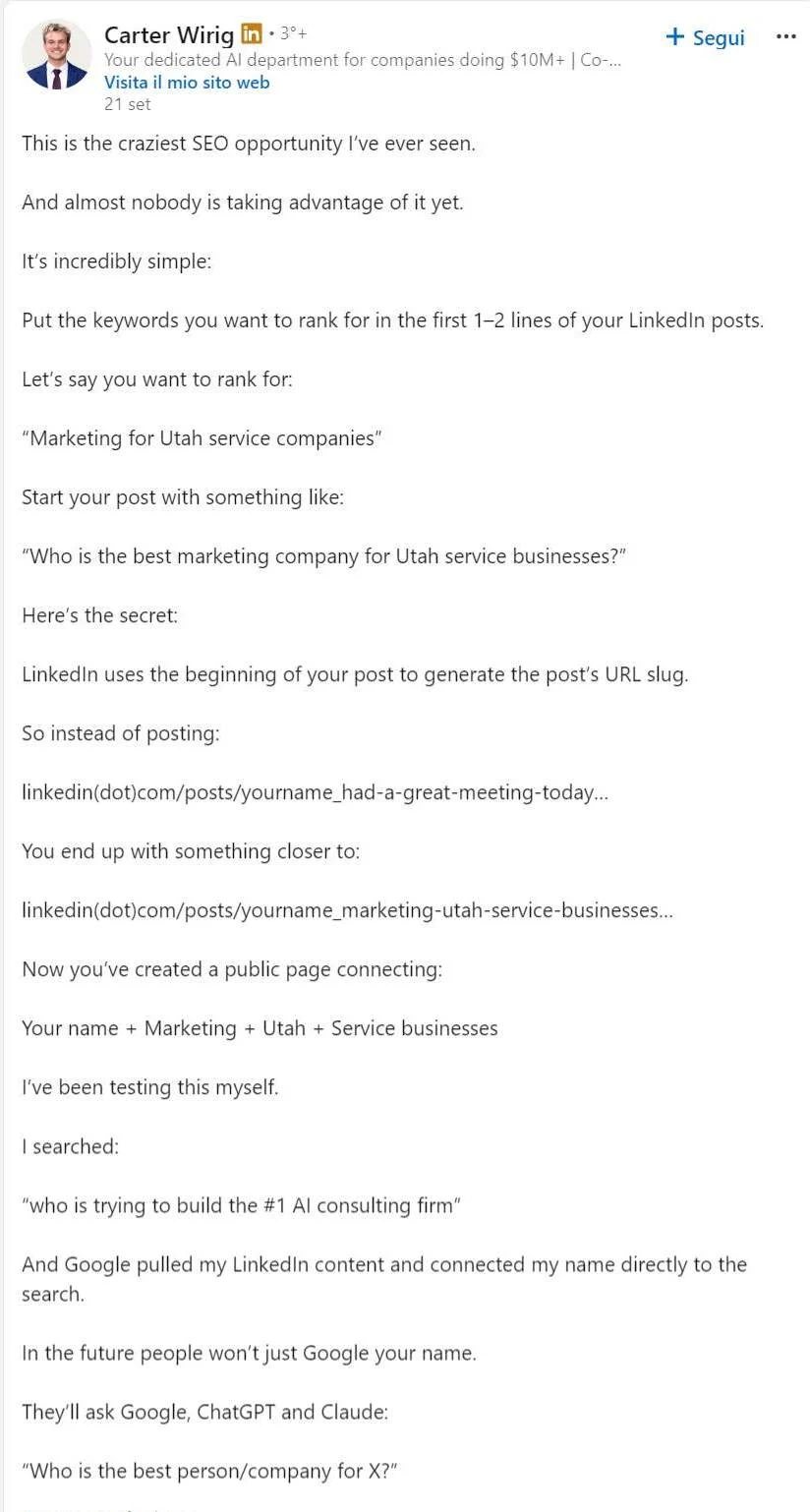
The core hypothesis seemed almost too straightforward: placing high-intent search terms within the opening lines of a LinkedIn update supposedly prompts the platform’s algorithm to write those exact phrases directly into the public URL slug. According to Wirig, this setup instantly establishes a crawlable public asset that ties your professional identity straight to those precise search queries.
It was a clever observation, certainly, but hardly enough to declare an algorithmic breakthrough on its own.
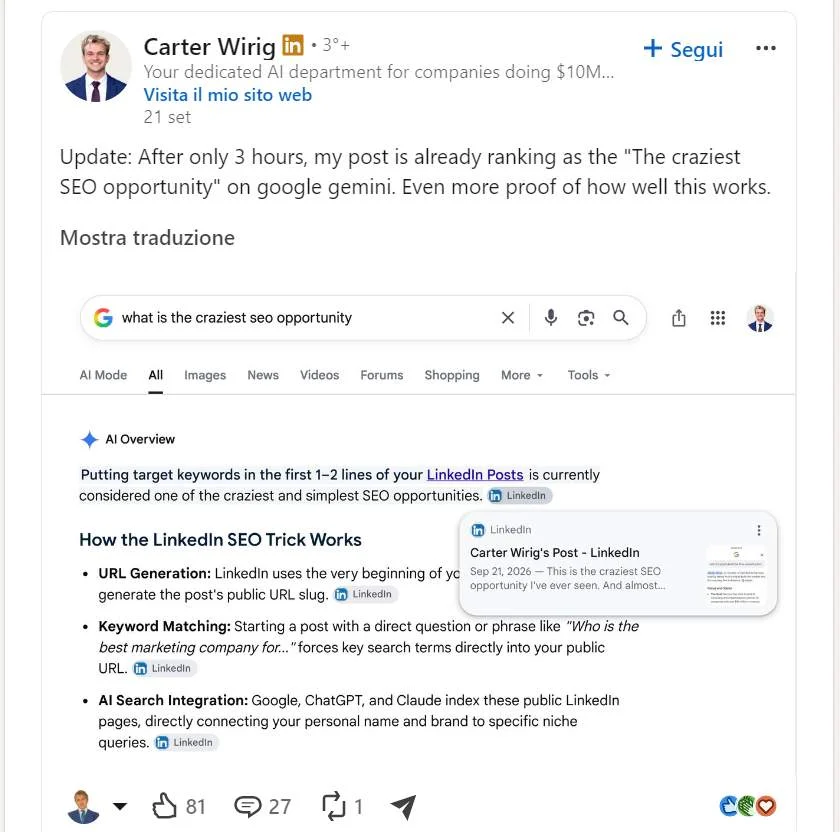
Then came part two: barely three hours later, a follow-up post showed that Google had already ingested the update and highlighted it inside Google AI Overviews for the exact target phrase “the craziest SEO opportunity”.
At that point, the right reaction was not scrambling to copy a surface-level social trick. The real task was breaking down the underlying mechanics: to what extent can LinkedIn shape how generative artificial intelligence models and search engines crawl, index, and cite business authorities?
The technical reality goes far deeper than a quick publishing shortcut.
Operational framework: turning LinkedIn into a systematic engine for SEO and GEO
If we want to stop treating LinkedIn updates as throwaway social blurbs destined to expire within a day, we must manage them as persistent, crawlable assets within the wider web ecosystem. You do not need an overwhelming workflow: simply build these core rules into your current publication routine.
1. Abandon generic formulas: target verified search intent
Everything starts by identifying a precise, practical question your target audience is already trying to resolve. Gathering these topics does not require guesswork: dig straight into organic query data in Google Search Console, review recurring questions from sales discovery calls, explore relevant Reddit communities, or analyze internal LinkedIn search habits.
The goal is never to build a post around an isolated keyword for its own sake, but rather to resolve a concrete knowledge gap that justifies an authoritative response.
2. State your core focus right away
The opening two sentences must outline your topic without conversational fluff. If your piece examines how generative search impacts ecommerce platforms, state that directly. Vague introductory remarks about “the fast-changing digital landscape” only encourage readers to keep scrolling while confusing semantic crawlers.
3. Provide hard, non-replicable value
Before you hit publish, answer one blunt question: does this copy offer details that an automated tool or generic blog post could easily produce?
To clear the threshold of real search relevance, you need primary depth:
- First-hand performance figures pulled directly from live campaigns;
- Transparent breakdowns of experimental setups and failed tests;
- Practical case studies detailed step by step;
- Raw interface screenshots validating every claimed figure;
- Original execution frameworks or logic workflows.
Official Google guidelines for building helpful, reliable, people-first content explicitly reward first-hand experience and original findings, while steadily penalizing redundant summaries of widely recycled web copy.
4. State key takeaways with total semantic precision
Large language models do not work well with conclusions buried beneath flowery prose. If you recorded a distinct shift in performance metrics, document it cleanly. Writing that “our prolonged research uncovered notable trends” provides zero structured data; writing that “evaluating 500 demoted URLs revealed that 72% suffered significant visibility losses across legacy top-tier queries” delivers a concrete, citable statement that search systems can extract effortlessly.
5. Guide audience journeys toward your owned properties
A single social post does not have to unpack an organization’s complete research archive. When delivering an extensive study or technical guide, the primary home for the complete resource remains your own web domain. A social post serves as the distribution hook to spotlight key data points, establishing a logical pathway:
LinkedIn post -> complete technical study on your owned site -> empirical verification assets
6. Replace casual assumptions with iterative testing
Drawing sweeping conclusions from a single test post is an unreliable approach. A proper methodology requires publishing ongoing content batches while consistently tracking core operational variables:
Subject theme -> opening syntax -> indexation timeline -> organic search visibility -> generative engine citation -> platform engagement metrics
By adjusting a single factor at a time (such as comparing a direct keyword opening against an interrogative hook or an analytical setup), twenty published posts will yield a reliable dataset rather than speculative marketing gossip.
7. Gauge reach beyond vanity social metrics
Measuring the true business value of published material strictly through superficial likes and quick comments provides an incomplete picture. The critical indicators of actual multi-channel reach include:
- Organic search impressions and clicks gathered across related long-tail terms;
- Measurable growth in branded search volume for company or executive entities;
- Qualified referral sessions routed directly back to owned site pages;
- Sustained appearance across standard index rankings and automated summaries;
- Unprompted citations and clean backlink references generated across your market.
Handled correctly, an individual post stops acting as a fleeting vanity asset and becomes a crawlable vector injecting validated expertise straight into modern search engines.
From standard rankings to Generative Engine Optimization: the mechanics of citation
Securing an entry in an index is merely the first baseline requirement. For an artificial intelligence system to extract a LinkedIn passage and use it inside a synthesized answer, it must map the semantic context and determine that the material directly satisfies the searcher’s core objective.
This reality highlights the practical divide between both search disciplines:
- Search Engine Optimization (SEO) handles the technical and contextual signals that enable index crawlers to find, parse, and place a specific page against a targeted query;
- Generative Engine Optimization (GEO) assesses whether the extracted data carries sufficient credibility, uniqueness, and structural clarity to warrant direct attribution inside an AI-generated synthesis.
This distinction shows why front-loading a target keyword quickly loses effectiveness if the underlying copy lacks factual weight. Inserting a keyword in line one may assist immediate classification and help build the URL string, but it provides zero qualitative merit to earn an algorithmic source citation.
Information processing follows a consistent sequence:
Index crawlability -> thematic clarity -> contextual authority -> formal citation selection
Semantic clarity directs traditional index evaluation and generative synthesis alike. As outlined in the comprehensive methodology guide on LinkedIn SEO and GEO by Anas Hidaoui, focused and concise technical writing gives parsing engines far more usable context than broad, generic commentary ever could.
Compare these two introductory strategies:
“Artificial intelligence is rapidly shaking up the search engine optimization industry.”
versus:
“Earning direct citations for LinkedIn research posts within Google AI Overviews is a major organic optimization play for 2026.”
The second statement removes structural ambiguity: it immediately signals the precise subject boundaries to search evaluators. Even so, clean phrasing cannot compensate for empty copy: without empirical verifications, documented observations, or proprietary data, no synthesis engine has a valid reason to reference that page as a source.
What makes a LinkedIn post worthy of an algorithmic reference
Once indexation takes place and the core theme is established, the evaluation shifts entirely to substantive merit: does this copy provide factual depth that justifies selection by an answer engine?
This is the dividing line separating indexed text from an authoritative reference. Evaluative search documentation continues to prioritize primary testing, verified field experience, concrete data, and undeniable personal accountability for the published work.
From an editorial standpoint, the operating rule is clear: stop rewording standard industry facts and publish specific insights you have personally documented.
Original data sets and proprietary observations
Conducting primary evaluations remains the most direct way to establish distinct value. Running a focused test, reviewing traffic movements across a network of client properties, auditing live search layouts, or gathering structured figures across your network produces authentic utility.
Rather than making empty claims about generative search reshaping user habits, you provide far greater authority by noting that across 2,000 commercial intent queries evaluated across fifty client domains, AI answers triggered on 34% of the target set. That specific data point delivers primary information that algorithms cannot easily locate anywhere else.
Detailed real-world case breakdowns
Hands-on operational documentation carries equal weight to broad statistical reports. Walking through what happened during an enterprise site migration, an internal linking restructure, or a tracking setup update following an algorithmic adjustment creates irreplaceable insight. On LinkedIn, verified identity is built into the ecosystem: authentic execution records will never be mistaken for automated summary content.
Direct solutions for complex technical issues
Another high-impact framework centers on addressing a tightly scoped technical hurdle with exhaustive clarity. Answering an intricate setup issue (such as why session parameters drop following a redesign) establishes a robust semantic profile and mirrors how users query search systems, both on standard engines and within the advanced parameters of the LinkedIn search filter architecture.
Well-reasoned non-consensus arguments
Echoing the prevailing industry consensus makes your copy blend into the background. Expressing well-documented skepticism toward an overhyped workflow, questioning conventional methodologies by showing real-world bottlenecks, or sharing anomalies detected across your testing accounts provides generative systems with unique, balanced perspectives needed to construct well-rounded answers.
In short: a relevant keyword outlines the topic, but primary supporting evidence forces search engines to consider it.
Should you open every post with heavy keyword placement?
The urge to reduce this whole concept to a simplistic routine (dropping a target phrase into sentence one and waiting for search engines to do the heavy lifting) is common among marketers seeking quick shortcuts.
Rigorous analysis points in a different direction. Wirig’s test serves as an informative observational study rather than an absolute, universal ranking switch. Official documentation regarding Google AI search features and generative enhancements confirms there are no special backdoors or secret tags required to appear inside generative answers outside of standard quality criteria.
Furthermore, human intent does not operate on static phrases. Adjusting a search query slightly changes generative answers completely, and attempting to manually target every conceivable syntax variation through individual updates is an unsustainable production strategy.
The practical takeaway is achieving immediate semantic focus. If your writing tackles a specialized challenge, making that premise explicit from sentence one strips away ambiguity, supporting fast parsing for automated crawlers that run parallel lookups to build answers. Optimizing your opening lines assists machine interpretation; expecting a single phrase to carry full authority without solid supporting content shows a clear misunderstanding of modern indexing engines.
Why this mechanism works: LinkedIn is part of the open web
The core structural reality that many web publishers overlook is very simple: a public post on LinkedIn does not sit behind a closed wall. Official platform documentation covering public visibility for LinkedIn content notes that all posts set to public access and their linked profile sections are fully readable by outside search bots, including Google, Bing, and the parsing engines behind conversational models like ChatGPT.
This layout means every public update operates across two environments at once: inside the home feed it sparks direct interaction with your professional network, while across the wider internet it functions as a standalone web page on a domain holding massive domain equity, indexed continuously by search crawlers.
Confirming that this visibility is not an isolated fluke, an analysis published by AmICited on LinkedIn citation rates inside Google AI Overviews reviewed more than 2,000 synthesized responses generated for B2B and software queries. The compiled data revealed that LinkedIn featured as a referenced authority in 1.2% of the surveyed results, ranking as the sixth most frequently cited domain across more than one thousand outside sources.
A 1.2% citation share does not suggest the network dominates synthetic search responses across every category, but it confirms a crucial reality: public updates on LinkedIn consistently populate the indexable knowledge pools that generative artificial intelligence queries to produce synthesized answers.
The real takeaway from this indexing case
The findings from Wirig’s test outline a clear operational capability: search engines maintain the real-time processing speed required to locate, evaluate, and present newly published platform posts inside automated overviews in a matter of hours.
At the same time, this reality does not make opening keywords an automatic ranking guarantee, nor does it ensure consistent citations for competitive, transactional search terms. Securing a temporary nod inside a dynamically assembled AI blurb is fundamentally different from building a permanent, high-ranking search footprint.
The key question is not how to game a fleeting technical nuance, but how to systematize your subject authority: LinkedIn is no longer just a networking feed, but an indexable publisher supporting your wider organic visibility strategy.
Practical conclusions
The case study we evaluated brings a straightforward fact to light: posting on LinkedIn means publishing directly to the open web.
This does not suggest that every informal status update will secure an automated highlight inside search summaries. It means, far more practically, that your presence on the network warrants the same methodical care applied to an indexable content program: drafting opening lines with precise semantic definitions, supplying unique data unavailable elsewhere, and giving search systems clear reasons to treat your analysis as an authentic, reference-grade asset.
A well-placed keyword can assist discovery; the verifiable substance of your material determines whether an algorithm treats it as an authoritative citation.